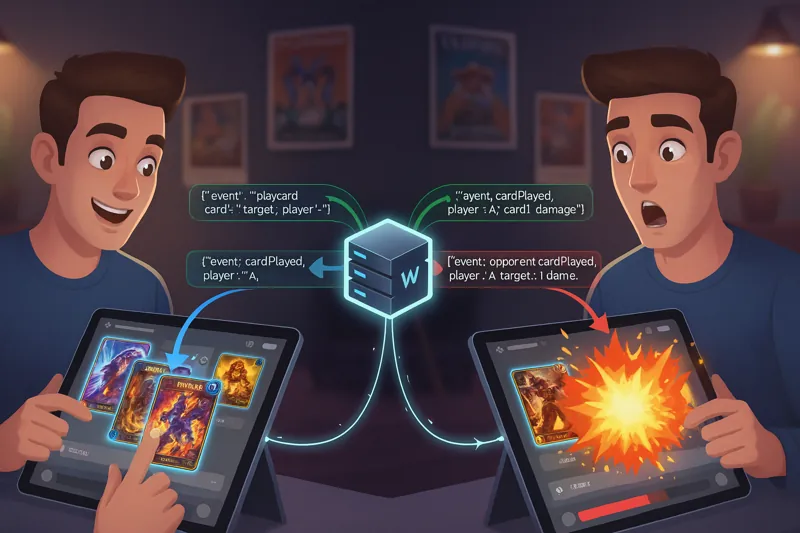
In 2025, when you open a casual game on your phone — whether it’s the chaotic party mayhem of Fall Guys, the social deception of Among Us, or a quick Slither.io match in your browser — you can instantly connect with players around the world and compete in real-time multiplayer battles.
That seamless, millisecond-level responsiveness — where every jump, punch, or tap feels perfectly synchronized — has become so natural that few players ever stop to think: how do these lightweight games manage to deliver such smooth, low-latency online play?
The secret lies in one of the most important technologies behind real-time connected experiences — WebSocket.
1. From Polling to Persistent Connection: How Real-Time Multiplayer Evolved
Before WebSocket, browsers communicated with servers primarily using the HTTP protocol — a request/response model designed for static web pages, not for dynamic multiplayer environments.
Each interaction looked like this: Client sends a request → Server responds → Connection closes.
If a player wanted to see updated data — for example, an opponent’s move in an online chess match — the client had to repeatedly ask, “Any updates yet?” every second.
That “polling” method caused high latency, wasted bandwidth, and created visible lag in real-time games.
To overcome this, developers tried several workarounds:
Short polling: Frequent requests; inefficient and bandwidth-heavy.
Long polling: Server holds the connection open until data is available, then closes it. Better, but still not truly real-time.
SSE (Server-Sent Events): Allows one-way communication from server to client — useful for notifications, but not for interactive play.
Then in 2011, the WebSocket protocol (RFC 6455) was standardized — bringing true two-way, low-latency communication to the Web.
2. What Is WebSocket? The Backbone of Real-Time Online Play
In simple terms, WebSocket is a persistent, full-duplex communication channel that lets the client and server exchange data freely over a single TCP connection — much like an always-open phone call instead of endless text messages.
How WebSocket Works
Handshake (HTTP Upgrade) The client initiates an HTTP request with a special header . The server replies with , officially upgrading the connection from HTTP to WebSocket.Upgrade: websocket101 Switching Protocols
Full-Duplex Data Transfer Once established, both sides can send and receive messages — text or binary — at any time. These messages can be small action commands (e.g., “playerJump”) or structured JSON packets containing movement and score data.
Persistent Connection & Heartbeats The connection stays open until manually closed or interrupted. To prevent timeouts by proxies or firewalls, client and server periodically send ping/pong heartbeats to keep the session alive.
Why WebSocket Revolutionized Online Multiplayer
Feature
HTTP Polling
WebSocket
Connection
Short-lived
Persistent
Direction
One-way (client → server)
Two-way real-time
Latency
High (hundreds of ms)
Very low (tens of ms)
Overhead
Heavy HTTP headers
Lightweight frames
Scalability
Weak
Strong for massive concurrency
According to research by Akamai, switching to WebSocket can reduce network load by 70 %+ and cut latency from 800 ms to under 50 ms — a crucial difference for any real-time battle or online multiplayer match.
3. Behind the Scenes: Real-Time Sync in a Multiplayer Mini-Game
Let’s break down what happens in a typical browser-based multiplayer platformer — say, a “jump and score” H5 mini-game.
Scenario:
Player A and Player B are matched into the same room.
The game must synchronize jump timing, movement, and scores in real time.
Simplified backend flow:
[ Player A ] ←→ [ WebSocket Server ] ←→ [ Redis Cache ]
                     ↑         ↓
                 [ Game Logic ] [ MongoDB Storage ]
Step 1. Establish Connection
const socket = new WebSocket('wss://game.example.com/ws?room=match123');

socket.onopen = () => {
  console.log('Connected to game server');
  socket.send(JSON.stringify({ type: 'join', playerId: 'A123' }));
};
The server authenticates the player and adds them to the corresponding multiplayer room.
Player B receives the message and animates Player A’s jump on-screen almost instantly — creating a seamless real-time multiplayer experience.
Step 3. Handling Lag, Sync, and Fairness
To ensure fairness and smooth motion across variable networks:
Snapshot Interpolation: The server sends global state snapshots (positions, scores) every 100 ms; clients interpolate smoothly.
Input Prediction: Players’ actions are shown locally first, then corrected based on server confirmation.
Server Authority: The final outcome (hits, collisions, scores) is computed server-side to prevent cheating.
Large platforms like Tencent Cloud and AWS GameLift use this WebSocket + server validation model, reducing exploit rates in online games by more than 90 %.
4. Scaling WebSocket for Massive Multiplayer Battles
While WebSocket enables smooth real-time gaming, supporting millions of concurrent players introduces new engineering challenges.
1. Connection Limits
A single Linux server can theoretically maintain tens of thousands of WebSocket connections, but each consumes 2 KB–10 KB of memory. At 50 000 players per server, that’s at least 1 GB of dedicated RAM.
Optimizations:
Horizontal scaling with load balancers (Nginx, Envoy, or AWS ALB).
Message queues (Kafka, RabbitMQ) to decouple real-time logic.
Edge computing nodes to reduce latency and handle regional traffic.
2. High Availability & Fault Tolerance
Session persistence: Store player state in Redis or a distributed cache.
Connection migration: If a node crashes, users reconnect to a healthy instance without losing their session.
Multi-zone deployment: Cloud WebSocket services (like those from AWS, Cloudflare, or Alibaba Cloud) often achieve 99.99 % SLA uptime.
3. Bandwidth and Compression
To improve performance over mobile networks:
Use Protocol Buffers instead of JSON (reduces data size ≈ 60 %).
Enable per-message deflate compression.
Dynamically adjust heartbeat intervals (Wi-Fi ≈ 30 s; LTE/5G ≈ 15 s) for better battery life and stability.
5. Beyond Games: WebSocket Across Real-Time Apps
Though born from the need for multiplayer gaming, WebSocket has become foundational for many real-time online applications:
Domain
Example Use Case
Online education
Live whiteboard collaboration, quiz competitions
Finance
Real-time stock and crypto tickers, order updates
IoT
Device telemetry streaming, remote monitoring
Social media
Instant messaging, live reaction feeds
Collaborative tools
Google Docs–style live editing and cursors
In short: anywhere data must move instantly between users, WebSocket keeps the conversation alive.
6. The Future of Real-Time Multiplayer Technology
While WebSocket remains the backbone of connected play, newer transport protocols are taking shape:
WebSocket over QUIC — leverages UDP to reduce handshake latency and improve packet loss tolerance.
Binary subprotocols — for more efficient serialization and deserialization.
Energy-aware mobile support — adaptive heartbeats to extend device battery life.
Industry analysts expect the real-time web application market to surpass $15 billion by 2026, with online multiplayer gaming accounting for over 30 % of that growth.
Next time you’re locked in a tight online multiplayer battle, perfectly timing your jump or counter-move, remember: that smooth interaction is powered by WebSocket quietly maintaining a stable, high-speed channel between you and every other player.
Behind every click and every frame of synced gameplay lies an invisible information highway — a network of persistent, low-latency connections enabling modern real-time experiences.
Casual games aren’t as “casual” as they look. And small protocols like WebSocket aren’t small at all — they are the hidden engines of our connected digital worlds.
Technology is in the details — and real-time connection reveals true craftsmanship.