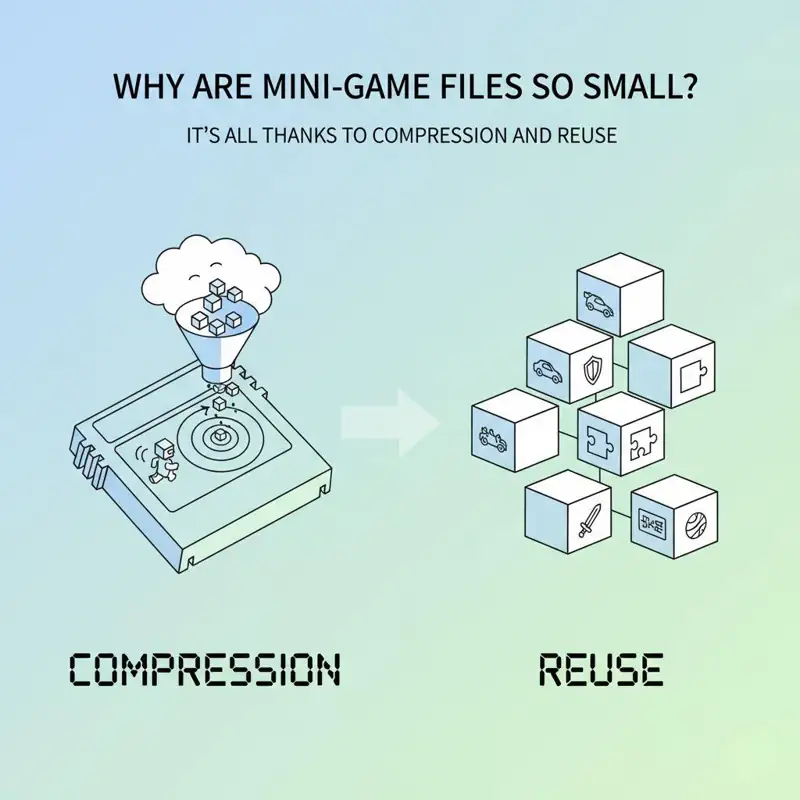
In the mobile internet era, mini-games have exploded in popularity thanks to their “tap-to-play, no-download-required” charm. Whether it’s Facebook Instant Games, Google Play Instant experiences, or browser-based HTML5 titles, these gems often clock in at just a few MB—or even hundreds of KB—while delivering smooth visuals, engaging mechanics, and crisp sound effects. This leaves many wondering: How do they pack so much punch into such a tiny footprint?
The secret isn’t sorcery; it’s a masterful blend of ruthless resource optimization, clever data reuse, and cutting-edge compression techniques. These strategies ensure every byte counts without skimping on fun. In this article, we’ll dive deep into the tech behind the magic, exploring how developers turn constraints into creativity.
Compression: Squeezing Every Last Bit of Value from Resources
At the heart of a mini-game’s slim profile is compression—transforming bulky assets into lean, mean machines. Images and audio, the usual space hogs, get the toughest love, but the payoff is huge: files that load in seconds on spotty connections.
Image Compression: From PNG to WebP, and the Power of Sprite Sheets
Visuals dominate a game’s resource budget, so devs start here. Traditional PNG or JPEG files bloat quickly, but savvy choices slim them down dramatically.
- Format Smarts: WebP reigns supreme for modern mini-games, offering 26-34% smaller files than PNG and 25-35% over JPEG at identical quality. It’s lossy or lossless, perfect for vibrant sprites or subtle gradients, and browsers like Chrome and Firefox natively support it.
- Color Depth Cuts: For pixel-art or cartoonish styles (think retro runners), dropping to 8-bit color—or lower—slashes sizes without noticeable loss. A 256-color palette handles most whimsy just fine.
- Metadata Purge: Tools like TinyPNG or ImageOptim strip EXIF data (e.g., timestamps, camera info) that’s irrelevant in games, freeing up KB effortlessly.
Layer on texture compression for hardware efficiency: In engines like Unity, formats like ETC2 (Android) or ASTC (iOS) crunch RGB data to 4 bits per pixel, turning an 8MB 2K texture into 1MB—a 87% win. Devs also enforce power-of-two dimensions (e.g., 512×512) to align with GPU quirks, avoiding wasted memory.
Enter sprite sheets (or atlas): Multiple images fused into one powerhouse texture. Instead of 40 separate frames for a character’s walk-jump-attack cycle (potentially 5MB scattered), one 512×512 sheet handles it all at 500KB. Benefits? Fewer HTTP requests (crucial for web loads), fewer GPU draw calls, and better compression ratios for the bundle. Games like Flappy Bird thrive on this, loading pipes and birds in a blink.
Audio Compression: Trading a Whisper of Quality for Major Space Savings
Sound can sneakily inflate files— a single uncompressed WAV track hits 10MB easy. But with perceptual tricks, it’s tamed.
- Low-Bitrate Encoding: MP3 or AAC at 64kbps (or lower) retains punchy effects and loops without ear fatigue, shrinking files by 90%. Unity defaults to Ogg Vorbis for non-mobile, platform natives for apps.
- Short Bursts Over Loops: Swap endless BGM for snappy clips (e.g., 2-second motifs) triggered by code, cutting storage while enabling seamless repeats.
- Dynamic Synthesis via Web Audio API: For basics like booms or clicks, generate tones on-the-fly with oscillators—no files needed. This zeros out audio overhead for procedural pings in puzzle games.
Take Doodle Jump: Its bouncy SFX? Compressed Ogg snippets totaling under 1MB, yet they amp the joy without bulk.
Reuse: One Asset, Endless Variations
Why hoard when you can recycle? Reuse turns scarcity into abundance, letting a handful of assets spawn worlds of content.
Sprite Sheets: The Ultimate Multi-Tool Texture
As touched on, sprite sheets aren’t just compressive—they’re reusable gold. UV mapping pulls sub-sections for animations, slashing I/O and boosting render speed by 50% in web titles. In Phaser (a lightweight HTML5 engine), auto-tools pack UI icons and frames effortlessly.
For 3D minis, LOD (Level of Detail) reuses models: Low-poly for afar, high for close—same files, adaptive quality.
Procedural Generation: Code as Content Creator
Ditch static packs for algorithms that birth levels endlessly. No extra bytes, infinite replay.
- Flappy Bird‘s pipes? Random heights and gaps, zero pre-baked assets.
- 2048‘s grids? Logic spawns merges on demand.
- Rogue-likes like Pixel Dungeon use seeds for procedural dungeons, fitting infinite adventures in KB.
This “code over cargo” ethos scales content without swelling sizes.
UI Reuse and Styling Harmony
Mini-games keep interfaces spartan, maximizing modularity.
- Template Magic: Core buttons and bars tweak via params (color, text, scale)—one base, myriad skins.
- Vector Over Raster: SVG or Canvas-drawn elements scale flawlessly, tiny at source (e.g., a progress bar as math, not pixels).
- Animation Reuse: Single tween logic, swapped params for fades, pulses, or spins across menus.
Code and Logic Optimization: Lean Engines, Modular Minds
Assets aside, code must diet too—bloated JS tanks performance.
- Lightweight Engines: Phaser or Construct 3 pack under 1MB, tailored for HTML5/mobile. Godot’s web exports hit similar slims via custom builds.
- Tree Shaking & Splitting: Webpack/Vite excises dead code; lazy-load modules so only active levels ship.
- Streamlined Logic: Focus on one hook (jump, match, tap)—skip heavy AI/physics. Crossy Road clones nail this: Simple rules, massive fun, minimal code.
Platform Limits: Constraints That Spark Innovation
These tricks aren’t optional; platforms enforce them.
- Facebook Instant Games: 6MB initial load (total bundle to 200MB), prioritizing snappy starts.
- Google Play Instant: Strict 15MB cap, pushing dynamic loads.
- HTML5 Web Games: Often self-imposed <10MB for itch.io or ad slots, gzip’d to 7.5MB.
Such caps birth ingenuity: AssetBundles for on-demand pulls, ensuring “one-tap wonder.”
Conclusion: Smallness as Smarts
Mini-games’ petite packages aren’t compromises—they’re triumphs of engineering elegance and artistic restraint. Compression wrings efficiency from pixels and waves; reuse multiplies magic from the mundane; procedural wits conjure infinities from code. Platforms’ guardrails? They hone the craft.
Next time you dive into an 800KB HTML5 hit, savor the unseen polish: Devs chiseling bytes like sculptors, chasing frictionless joy. As the saying goes—greatness lies in simplicity. In the mini realm, small is profound.